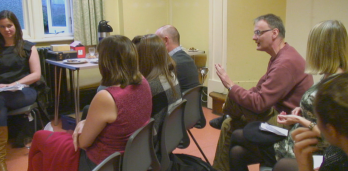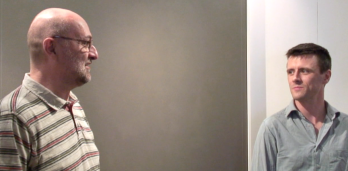
A few weeks ago, right after we opened at APT Gallery, I met art historian and curator Ben Street at the conclusion of Three Fields, a show he curated at No Format Gallery of works by Emma Cousin, Matthew Luck Galpin, & Charles Olgilvie. We had a lovely discussion about curation, abstraction, and whether there was any truth behind the idea of a ‘centre of art’ in the art world, which Ben discussed with art history PhD candidate Nicole – another American. Ben asked me how This ‘Me’ of Mine was going. I said I was very pleased with the turnout for the opening at APT and I was hopeful for some reviews of the show. Ben commented on how difficult it was to get reviews and as curator it’s really good to have that after doing all that work. I agreed and replied, “it’s not about the attention though, I kind of hope someone says ‘this is crap’ so I can respond and engage the debate. After all this work, I want to discuss it.” My response pleased Ben, which pleased me.
I’ve been granted my wish, not from an art critic, but from a member of ‘the audience’, Jeremy. I use that term because he referred to himself as ‘the audience’, I’ve always felt slightly uncomfortable with that phrase because it is very grand and seems it should be followed by an acknowledgment of the orchestra in the pit. Jeremy and I had a stimulating discussion about the role of the audience in art presentation and how often it is disregarded and dismissed. This topic is significant for me as a curator and new organisational director because it is the very issue I want to address in this work. As an artist, I’ve been concerned with this issue for a long time.
Jeremy wrote this statement in response to seeing This ‘Me’ of Mine in Folkestone:
“These thoughts are in no way a criticism of the artists, their works or the curator. All creativity is an inspired blessing and as such any thoughts here are purely ideas and observations and wandering impressions.
What initially struck me was the scale and scope of the curator’s objectives summarising this ‘Me of Mine’. A fascinating exploration, philosophical bordering on the metaphysical and indeed a subject demanding debate in the round? Indeed, the excitement and challenge generated prompted the immediate question – ‘How far was such a debate explored and extended by the exhibits?’ In short the answer was ‘Not very deeply and not very far’ but this was primarily the fault of the exhibits, but this is a fundamental challenge to art at any level. As an example take Iris’ Stocking. To what extent was perception and interpretation informed by having the delightful back story explained? The answer has to be ‘hugely so’ and this therefore begs the question of the impacts of the piece in its own rights – without the context of the back story. This question of context being a theme of the curator the juxtaposition of ideas here is beautifully complex! And yet the question of how well the works perform in their own right is troubling. I won’t waste time with banal considerations of ‘good’ or ‘bad’ here but a central function of any arts piece should be provocation. Indeed, at an intellectual or aesthetic level the audience should be challenged, enraged, amused, amazed, blown away or any other emotion you would care to mention or intellectualise and yet most pieces failed to achieve this. ‘Why?’ or ‘What’s the point?’are stunningly good questions if the audience are provoked to explore such simple yet complex questions rather than use them as articles of fleeting criticism.
Related to the question of provocation as function is the question of dexterity of form. If the piece operates on an intellectual level when the audience is provoked to what extent might they enjoy the piece on an emotional level either due to provocation of idea or the form of the piece in its own right. Such a question is difficult but the issue of dexterity must come to the fore. Perhaps the Glass Menagerie is a useful example. Ostensibly a collection of everyday animal trinkets arranged with a minimum of dexterity on an everyday table, how can the audience be expected [to engage] on an emotional level? Sadly this challenge also applied to several other pieces. Such opening up of the artistic process to those not naturally ‘gifted’ is to be thoroughly recommended at an individual level but when placed in front of an audience different criteria are at work. If it looks mundane, sounds, mundane and feels mundane then it probably is mundane!?
And yet I finish by being confounded by my own arguments. Having been prompted to spend an enjoyable hour thinking, reflecting, arguing with myself and ultimately to articulate vague, half formed ideas I have to thank the curator and all the artists involved for a wonderful experience.”
Jeremy Wilson
My first response to Jeremy’s criticism to provocation by the artworks and their failure to do so is – this expectation is a limitation, unrealistic and a function of the ‘society of the spectacle’ as discussed in Guy Debord’s book by the same name, the postmodern world in other words. That is not to suggest however, that artworks should not strive to achieve this, but the desire for artworks to ‘provoke’, I suggest, is the result of a consumerist society. What happens if this expectation is removed and the artworks are viewed on face value – ‘what you see is what you get’, which is related to J.G. Ballard’s quote, ‘you find what you’re looking for’. If this were the expectation rather than provocation Jeremy would feel justified to like or dislike a work and not feel troubled that somehow the work was lacking because it didn’t provoke or that his own intellect was lacking because he ‘didn’t get it’. If this expectation to provoke was removed, artists would also feel less pressure to be shocking or provocative. How much art is made to this aim? And how numb have we become to this measure? I can answer that and I’m sure you can too. Without the expectation to provoke perhaps art would be made to communicate instead, which I suggest is as provocative a stroke as any contrivance to provocation.
An area of art which I find sorely lacking is the reading of art, not only by viewers but by artists as well. The notion that the art work should ‘speak for itself’ is an out-dated modernist approach to viewing art. It was an aim of Abstract Expressionism for viewers to feel a response directly as a result of the artists’ interactions with paint and canvas, a desire to elicit emotion from the viewer. The reading of art must be in tune with the times just as the production of art is tuned into its time. We no longer live in a post-war world. We live in a world of information and hyper-connectivity with media overload as a constant in our lives. I suggest because of this and as a result of this a contextual communication with art is appropriate, necessary and beneficial. However, this is not without risk. There is a fine line between too much information and not enough. Nor is this meant to suggest it is no longer possible or appropriate to have an aesthetic experience with art. I’m suggesting an openness to both the aesthetic experience and the contextual information. Art made to provoke ideas is not going to be in your face, and expectations of grandeur may not be appropriate for all works of art. A flexible approach to viewing art requires a flexible approach to expectation, or in other words, match the expectation to the art. Some of the most stunning works I have ever seen have also been the most quiet and unassuming (Vija Celmins comes to mind). Jeremy’s claim that art works should challenge the audience, enrage them amuse, amaze or blow them away is a hefty demand. I don’t disagree with this, but it is important I think to realise the depth of this expectation. He later mentions a ‘provocation to ideas’ by an artwork. Now that is a more realistic expectation and one which I agree every artist should attain in their work.
He goes on to suggest dexterity in the production of an artwork must ‘come to the fore’, to use his phrase. While I agree fine craftsmanship is important in the production of art, I question the notion that this has to be exhibited through the display of exceptional manual skills, which seems to be what Jeremy is seeking. His criticism of the ordinariness of the table and minimally dexterous arrangement of the animals in Cathy Lomax’s Glass Menagerie, I suggest is part of the sensibility of the work and it’s in this sensibility where the ‘dexterity’ lies. In a post-conceptual world (if that is indeed where we are) sensibilities, observations, linkages, appropriations, constructions and symbolisms all carry weight in being exceptional, not just in the dexterity of manual skill, which could also be called mastery. A mastery of linking observations can be a subtle thing, but its subtlety does not mean it is not masterful. Careful observation of the mundane is likely to produce a work which appears mundane. A failure to recognize the subject of the piece as the mundane, for example, will almost certainly miss the mastery in the observation of the subject. Presumably, when Jeremy uses the word ‘mundane’ he also suggests ‘mediocre’? If this is the case, where in fact does the mediocrity lie? I ask that not in criticism of Jeremy’s intellect which I found to be well above average; his willingness to bother to engage as deeply as he did also indicates a stance well beyond the mean. But the fact remains that perception remains a barrier. Is the work and/or the presentation a mediocrity if it is perceived as such? Is it a mediocrity and possibly a failure if the depth and layers of meaning have not been recognised? Can this barrier be breached without the risk of being dictatorial? How much information is too much and when is too little a detriment? We can never know because we can never know the mind of another. Do we give up then?
I would defend Cathy’s work by suggesting she displays a mastery of form through the repetitive visual motifs in the film aspect of Glass Menagerie which she overlays onto similar shapes and forms in her table of glass animals. Also the appropriation of the themes in Tennessee Williams play have bearing on the meaning of the piece, adding a conceptual layering which mirrors the layering of light and shadow in her piece. Jeremy and I had an interesting discussion comparing Cathy’s work with Kate Murdoch’s, It’s The Little Things as both pieces use the placement of objects. Jeremy responded positively to Kate’s work appreciating and acknowledging the ‘dexterity’ involved in Kate’s careful arrangement of objects. However, the randomness of Cathy’s objects was a barrier for him. Once I pointed out the repetition of forms i.e. the swan in the film (which he had not recognized as a swan) and the swan figurines, and explained some of the concepts in Williams’ play, which Jeremy wasn’t familiar with; he felt he should consider the piece further – a gain for communication.
I was in Asda and overheard this brief exchange between Jason and his mum:
Mum: “Jason will you stop following me around everywhere.”
Jason: “I have to.”
This remarkable response from a child who implicitly understood the dynamic of his position in relationship to his mum I think holds the key to communication through art as something like this:
In a multiplicity of subjectivity (much like being in Asda or any other mega superstore chain):
From those who don’t question: “Will you stop explaining and demanding.”
Response from those who question: “I have to.”
Jeremy is not wrong to find a lack and he is not lacking because he perceived a lack. The artwork is not mundane because Jeremy found it so, nor is it exalted because its meaning was not perceived; it is what it is and Jeremy is who he is. Hopefully a willingness to question will help us to come together to breach the barriers. I think Jeremy presents the answer to his own questions by writing: “Having been prompted to spend an enjoyable hour thinking, reflecting, arguing with myself and ultimately to articulate vague half formed ideas I have to thank the curator and all the artists involved for a wonderful experience.” That’s all we wanted we wanted to provoke, so I think we succeeded.
Thank you Jeremy, for presenting the views of ‘the audience’, and a round of applause for the orchestra in the pit.
Like this:
Like Loading...